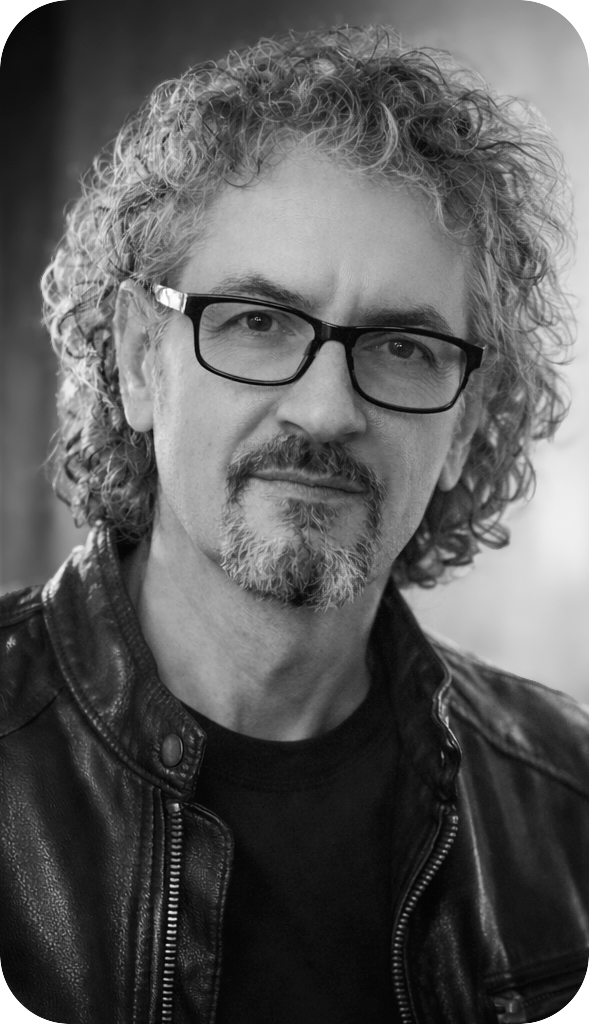
/ Much of my life has been spent looking at things from slightly outside the frame.
From an early age, I felt somewhat out of place within the environments around me. Rather than settling into a single way of seeing things, I became curious about how different systems worked — and what happened when they were brought into contact with one another.
That curiosity led me through architecture, music, colour and graphic design, and eventually across disciplines, cultures and continents. Over more than twenty years working between Asia and Europe as a Creative Director, artist and consultant, I became increasingly interested in how systems construct meaning — and how changing the way we look at them can change what we see.
This gradually opened the way toward psychology, philosophy and cognitive sciences, and eventually symbolic systems.
Tarot isn't the beginning of this story. It is one of the later instruments I found for something I've been doing for a long time: using symbols, associations and alternative perspectives to step outside habitual ways of thinking.
Today, I call this Symbolic Thinking.
FULL BIOGRAPHY →
Mirko Adami resists easy categorisation.
Not because of ambiguity, but because his work has always unfolded across disciplines rather than within a single one. He operates at the intersection of art, design, strategy, and symbolic thinking — artist, designer, creative director, consultant, each role a different lens on the same sustained inquiry. What connects these identities is not a job title, but a sustained engagement with narrative, meaning, and the systems through which ideas take form.
Educated in architecture, music, colour, and graphic design, Mirko has spent over twenty years working between Asia and Europe — holding senior creative roles within Australian, British, American, Singaporean, Chinese, and Italian branding and advertising agencies, shaping brand narratives and design languages for clients across vastly different cultural and commercial contexts.
His work has involved collaborations with international and multinational clients including HTC, Starbucks, Coca-Cola, Sony, Nippon Paint, Audemars Piguet, General Motors, Hennessy, WWF, Hilton Hotels and Le Royal Meridien, as well as cultural institutions, independent studios, and early-stage startups. During his years in China he also taught and lectured on colour design and creative expression.
Alongside his commercial practice, Mirko has consistently developed independent artistic projects. He was among the co-creators of the virtual art gallery Dimensioni Parallele, the collective artist Yasutomo Kawai, and the techno-art band Impotenti — presenting installations and performances across several Italian cities. While based in Asia, he co-founded the avant-garde duo Deus Ex Machina, producing audio-visual live performances that reinterpreted medieval music and iconography through contemporary technologies.
As a solo artist, his work explores the emotional and psychological dimensions of human experience through photographic collages, visual juxtapositions, and psycho-cinematic music influenced by neoclassical, psychedelic, ambient, and electronic traditions.
He also maintains an ongoing critical investigation into the paradoxes of contemporary society — particularly those embedded in marketing, religion, politics, and systems of belief. This takes form in Mocking Mock-Ups, a body of work that uses the language of commerce to expose its own contradictions.
Across these practices runs a single thread: an investigation into how symbols, narratives, and structures shape perception, and how reconfiguring them can open new ways of seeing, thinking, and acting.
Running alongside this work has been a sustained interest in psychology, philosophy, and cognitive sciences. Over time, these interests converged with his experience of art, design, narrative, and different cultural systems — and eventually with tarot's symbolic language.
Tarot is not approached as a system of belief or prediction, but as a reflective framework: a structured way of introducing symbolic distance, disrupting habitual patterns of thought, and opening alternative perspectives. Drawing on Jungian archetypes and informed by his artistic sensibility, Mirko uses symbols to create space for deeper inquiry, reframing, and discovery.
Today, Mirko integrates his artistic, cultural, and professional experiences to help individuals and groups re-examine the questions they ask, explore overlooked possibilities, and find a clearer position from which to act. This synthesis enables forms of insight that operate across personal, cultural, and organisational contexts, where clarity emerges not only through simplification, but from holding complexity long enough for it to reorganise.